

Today marks the one-year anniversary of the Washington Supreme Court’s decision in Brown v. Old Navy, LLC, 567 P.3d 38 (Wash. 2025). In response to a certified question from the U.S. District Court for the Western District of Washington, the court held that the Commercial Electronic Mail Act (CEMA), RCW 19.190.020(1)(b)—an anti-spam statute enacted in 1998 to prevent spammers from disguising junk mail—prohibits “any” false or misleading information in a commercial email’s subject line. That decision has opened the floodgates to a tidal wave of litigation, with plaintiffs shoehorning false advertising theories into this decades-old subject line statute to pursue whopping statutory penalties of $500 per violation.
When the Brown case first went up on appeal, we saw the writing on the wall. Some of us took the Washington Bar exam. Others, in the middle of searching for a new law firm, prioritized firms with significant Washington bench strength. We contacted the Washington Retail Association and initiated a CEMA reform effort. We trained numerous clients on subject line compliance. And now, we are defending over a dozen of these lawsuits. Suffice it to say, we are not providing this recap from a detached vantage point.
Below, we provide a comprehensive update on the past year’s developments, what we’ve learned on the frontlines, and where CEMA litigation appears to be heading.
CEMA 101
For those uninitiated, the section of CEMA at issue in these lawsuits is Wash. Rev. Code § 19.190.020(1)(b), which prohibits any email that “[c]ontains false or misleading information in the subject line.”
In Brown, the district court certified the following question: Does RCW § 19.190.020(1)(b) “prohibit the transmission of a commercial email with a subject line containing any false or misleading information, or is the prohibition limited to subject lines containing false or misleading information about the commercial nature of the email message?"
On April 17, 2025, the Supreme Court answered this question, saying that “[T]o violate subsection (1)(b), an email subject line does not need to deceive consumers about the subject or purpose of the email—it merely needs to contain false or misleading information.”
And here’s why CEMA is scary: the statute provides for statutory penalties of $500 per violation, which plaintiffs interpret as meaning per email, per recipient. That means a single email, sent to 5,000 Washington recipients, could result in $2,500,000 in damages. One email a month for the four-year limitations period, in turn, could mean $120,000,000 in statutory liability. A violation of CEMA is a per se violation of Washington’s Consumer Protection Act (CPA), and many plaintiffs claim that means the penalties can be trebled (we disagree).
Washington’s Litigation Gold Rush
A whopping 105 CEMA lawsuits have been filed since Brown was decided in April 2025. The vast majority of these suits have been filed by out-of-state plaintiffs’ firms who flocked to Washington to cash in on CEMA’s litigation gold rush.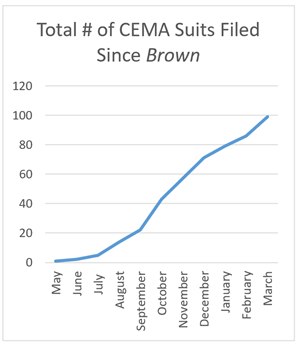
While most of these suits have targeted retailers, they have also been filed against hotels, restaurants, cosmetic brands, and more.
Many of these suits have targeted subject lines similar to those at issue in Brown, which involved “limited time” or “expiring” sales that were subsequently extended (allegedly as part of a pre-planned advertising strategy). Others have targeted subject lines promoting “free” gifts, where the body of the email explains that a threshold purchase is required.
Many cases have been filed in conjunction with suits in California and Oregon alleging false or deceptive reference prices, based on the theory that the retailer perpetually offers items at a discount. Applying the same theory, the plaintiffs in these cases claim that any subject line even mentioning a sale amounts to a CEMA violation.
Remarkably, to our knowledge, not a single plaintiff in any of these cases claims to have actually read any of the challenged emails—much less made a purchase as a result of the email’s contents. Nonetheless, plaintiffs seek $500 in statutory damages for each class member, for each allegedly wrongful email received—often adding up to over a billion dollars per case.
CAN-SPAM Preemption: The Threshold Question
In most of the new CEMA cases, defendants have moved to dismiss on the grounds that plaintiffs’ claims are preempted by the federal Controlling the Assault of Non-Solicited Pornography and Marketing Act, 15 U.S.C. §§ 7701 et seq. (CAN-SPAM). Congress enacted CAN-SPAM in 2003 to create a uniform national standard for commercial email regulation, and included a broad preemption provision covering state laws that “expressly regulate the use of electronic mail to send commercial messages.” 15 U.S.C. § 7707(b)(1). Defendants argue that CEMA falls squarely within this preemption; plaintiffs counter that their claims fit within a “limited, narrow exception” recognized by the Ninth Circuit for state laws prohibiting “falsity or deception.”
So far, these motions to dismiss have not succeeded. District courts in Washington have uniformly held that CEMA claims for “false or misleading” subject lines—even without allegations of reliance, materiality, or injury—fall outside CAN-SPAM’s preemption. However, defendants in at least two cases have sought interlocutory appellate review, and those rulings could reshape the landscape.
CEMA Reform: A Legislative Response
Normally, it can take years of litigation before legislators consider statutory reform. For example, Michigan did not amend its Preservation of Personal Privacy Act, until after the appellate courts issued several unfavorable decisions, and several large publishers settled for tens of millions of dollars each. In Illinois, BIPA was passed in 2008 and was the subject of onerous litigation until it was amended in 2024. And the California Invasion of Privacy Act (CIPA) has been the subject of thousands of lawsuits, with reform still out of reach.
In Washington State, by contrast, the legislature impressively proposed HB 2274 after just several months of litigation, with Governor Ferguson signing the bill into law on March 23, 2026. Effective June 11, 2026, the bill: (1) reduces the statutory penalty from $500 to $100, and (2) adds a more explicit scienter requirement to CEMA’s prohibition on including false or misleading information in the subject line. 2274-S.SL (69th Leg. 2026 Reg. Session) (effective date June 11, 2026). Perhaps more importantly, this legislative effort shone a spotlight on the potentially devastating effect that CEMA has on retailers. The discussion of further amendment is planned for the next legislative session, after the wave of lawsuits has percolated.
Navigating Compliance in Uncertain Times
At a hearing before the House Consumer Protection & Business Committee, Representative Jeremie Dufault asked an opponent of the CEMA reform bill to identify a subject line—any subject line—that would not be at risk of a CEMA lawsuit. She couldn’t think of one.
Indeed, before Brown, the Attorney General’s Office had published guidance on its website explaining that “[o]ne of the easiest ways to tell if an email violates Washington’s spam statute is to take a look at the subject line of the email and compare it to the text of the message,” and that a subject line does not violate CEMA if it “clearly represents what is being sent.” After Brown, that straightforward guidance was deleted from the AG’s website.
With no clear judicial standard for what makes a subject line “false or misleading” under CEMA’s expanded interpretation—and with the AG’s prior compliance guidance now deleted—companies face significant uncertainty. Most cases remain in early stages, with little appellate precedent. Numerous questions will need to be decided, many of which would provide grounds for dismissal based on the limited factual allegations in these cases. For example:
- Even the plaintiffs’ bar recognizes that materiality is required to avoid CAN-SPAM preemption. But what does that mean in the context of a subject line that nobody claims to have read? Does the recipient need to have found it material? Does the subject line need to have caused a purchase? Is it even plausible that a subject line—meant to be a one-line preview of an email—would cause a purchase?
- How does the relationship between a subject line and the body of an email come into play? Is an email deceptive if it accurately reflects the content of the email?
- What about pre-headers? Is a pre-header a subject line? Can a disclosure in a pre-header prevent deception?
- In light of recent decisions holding that reasonable consumers understand that asterisks lead to qualifying disclosures, is an email deceptive if it includes an asterisk leading to disclosures within an email?
Until courts at the trial and appellate level address these core issues, our understanding of the nature of CEMA litigation is drawn largely from the complaints themselves.
What we do know is drawn largely from the complaints themselves. Plaintiffs have targeted a range of common marketing practices, including urgency-based promotions (“limited time,” “ending soon”), discount claims where the baseline price may be questioned, and “free” or BOGO offers where the underlying economics are challenged. The breadth of these theories—and the lack of any safe harbor— has left companies questioning whether any promotional subject line is truly risk-free.
Trends Outside Washington
Adding to the complexity is the fact that CEMA cases are now just one piece of a broader patchwork. Companies sending commercial emails nationwide must consider not only Washington State’s statute, but also the analogous laws emerging as litigation targets in Maryland, Indiana, Florida, and potentially other states. Each jurisdiction may interpret its statute differently, and what passes muster in one state may not be actionable in another.
Over the last year, plaintiffs’ lawyers have quickly sought to leverage Brown to pursue similar claims under analogous anti-spam statutes in other states—many of which have sat dormant for decades. In Maryland, plaintiffs have filed over a dozen class actions under Maryland’s Commercial Electronic Mail Act, Md. Code, Com. Law § 14-3002, arguing that the statute was modeled after CEMA and should be interpreted consistently with Brown. Indiana has also seen a wave of new filings. And just last week, the first class action was filed under Florida’s Electronic Mail Communications Act. Other states with similar anti-spam statutes—including Kansas, North Dakota, and Washington D.C.—may be next. Many of these laws have generated little to no litigation since their enactment, but that appears poised to change.
Conclusion
One year after Brown v. Old Navy, the decision’s impact has far exceeded what most observers anticipated. What began as a narrow certified question about the scope of Washington’s anti-spam statute has transformed into a nationwide litigation phenomenon—spawning a hundred class actions in Washington alone and inspiring copycat suits across the country.
The legal landscape remains unsettled. Federal preemption arguments have thus far failed to gain traction at the trial court level, though interlocutory appeals may soon test those rulings. Article III standing questions linger. And the recent amendments to CEMA—while a positive development for defendants—have yet to be interpreted by the courts.
Meanwhile, the plaintiffs’ bar shows no signs of slowing down. With statutory damages creating potentially massive exposure and new state laws being dusted off for the first time in decades, the financial incentives for continued litigation are clear. Companies that send commercial emails— particularly those with promotional or marketing content— should expect this area of law to remain active for the foreseeable future.
We will continue to monitor developments in CEMA litigation and the emerging cases in other jurisdictions. As courts begin to grapple with the harder questions—preemption, standing, scienter, and what “false or misleading” actually means in practice—clearer guidance may finally emerge, particularly with the help of appellate guidance. Suffice it to say, Brown’s first birthday likely won’t be its last.
Ballard Spahr’s Retail and E-Commerce Team is at the forefront of spam email litigation and retail pricing regulation, with particular depth in CEMA. If you have questions about CEMA or our team’s capabilities, please reach out to us.

Meegan Brooks (in front of the green flag) is shown at the signing of HB 2274 by Washington Gov. Bob Ferguson, with the Washington Retail Association’s Interim Executive Director Alesha Shemwell (fourth from left) and Director of Policy and Government Affairs Crystal Leatherman (also in front of the green flag).

Meegan Brooks (rear, in blue) joined supporters of CEMA reform with Washington Gov. Bob Ferguson.
Washington Retail Association Director of Policy and Government Affairs Crystal Leatherman is shown to the right of Meegan.
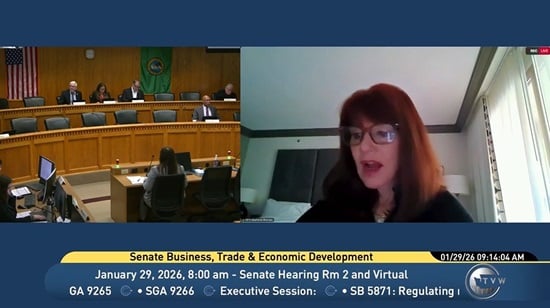
Stephanie A. Sheridan provides testimony to the Washington State legislature as it considers CEMA reform.
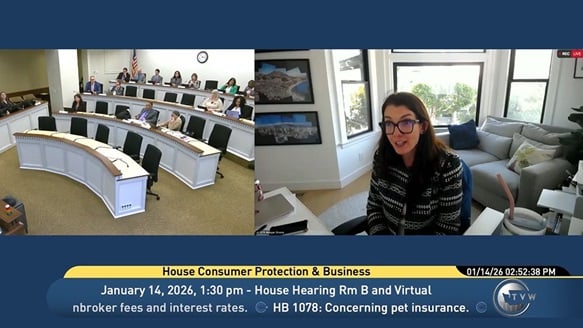
Meegan Brooks provides testimony as the Washington state legislature considers CEMA reform.

Subscribe to Ballard Spahr Mailing Lists
Get the latest significant legal alerts, news, webinars, and insights that affect your industry.
Subscribe Copyright © 2026 by Ballard Spahr LLP.
www.ballardspahr.com
(No claim to original U.S. government material.)
All rights reserved. No part of this publication may be reproduced, stored in a retrieval system, or transmitted in any form or by any means, including electronic, mechanical, photocopying, recording, or otherwise, without prior written permission of the author and publisher.
This alert is a periodic publication of Ballard Spahr LLP and is intended to notify recipients of new developments in the law. It should not be construed as legal advice or legal opinion on any specific facts or circumstances. The contents are intended for general informational purposes only, and you are urged to consult your own attorney concerning your situation and specific legal questions you have.